

Sustainability: The time is now
Human beings are a relatively new species in evolutionary terms. Yet today, humanity is the main driver of biodiversity loss, climate change, and other serious problems that put the continuity of life as we know it at risk.
In response to this situation, the United Nations defined the Sustainable Development Goals (SDGs), with targets to be achieved by 2030. However, progress toward these goals is being undermined by multiple crises: wars and geopolitical tensions, deep social inequalities, and the lack of genuine commitment from some of the world’s most powerful countries.
Even so, there is still hope. Accelerating progress toward the SDGs remains possible, but only if global, coordinated efforts are undertaken to drive the necessary transformations. In this context, companies—interconnected as part of a broader ecosystem—play a critical role as agents of change, helping to build a world that is more environmentally responsible, inclusive, and fair.
A race against time
As of July 2025, progress toward the SDGs remains alarmingly slow. It is estimated that less than 20% of the targets will be achieved on time by 2030, according to the Sustainable Development Report 2025.
This year marks a decade since the adoption of the 2030 Agenda. In this context, UN Secretary-General António Guterres stated during the presentation of the July 2025 progress report that only 35% of the targets are “on track or showing moderate progress.”
COP30 (the United Nations Climate Change Conference), which concluded on November 21, took place at a critical moment: for the first time, the planet surpassed the 1.5°C global warming threshold compared to pre-industrial levels—the limit science considers essential to avoid the most severe impacts of climate change.
The priorities of COP30 focused on strengthening multilateralism, connecting the climate crisis to everyday life and human rights, and ensuring that the most affected communities actively participate in negotiations and receive real support to adapt.
Along the same lines, efforts were made to accelerate the implementation of the Paris Agreement, with a strong focus on protecting the Amazon, climate finance—particularly the USD 1.3 trillion per year pledged—and a just transition, including the gradual phase-out of fossil fuels and increased support for developing countries.
The year 2030 is just over four years away. The time to act is now.
And still, with hope, the words of No Te Va a Gustar resonate:
“There is something that remains alive
It renews our hope
And in the final breath
Oh, sky-blue, give me a Sun”
Our planet, which appears sky blue from space, is the source of life itself. Caring for it is a collective responsibility, so that life may continue in a form as close as possible to what we know today, and so that each morning, it can continue to gift us a new sunrise.
What the SDGs are and how they are measured
In 2015, the United Nations launched the 2030 Agenda for Sustainable Development, a global strategy aimed at achieving 17 Sustainable Development Goals and 169 targets during this decade, encompassing the economic, social, and environmental dimensions of development.
Since 2016, the Sustainable Development Solutions Network (SDSN) has published regular reports assessing countries’ progress toward the SDGs. The methodology is based on an SDG Index, which aggregates results from 102 indicators (2025 edition) into a single score, giving equal weight to each goal.
The index ranges from 0, representing the worst possible performance, to 100, indicating the highest level of SDG achievement.
Global SDG progress as of July 2025
The data show continued European leadership, particularly among Nordic countries, with Finland in first place. Even these countries, however, face significant challenges related to climate change and biodiversity.
East and South Asia stand out for having outpaced other regions in the rate of progress, while in Latin America and the Caribbean, economic growth of 2.5% is projected for 2025, albeit with downside risks.
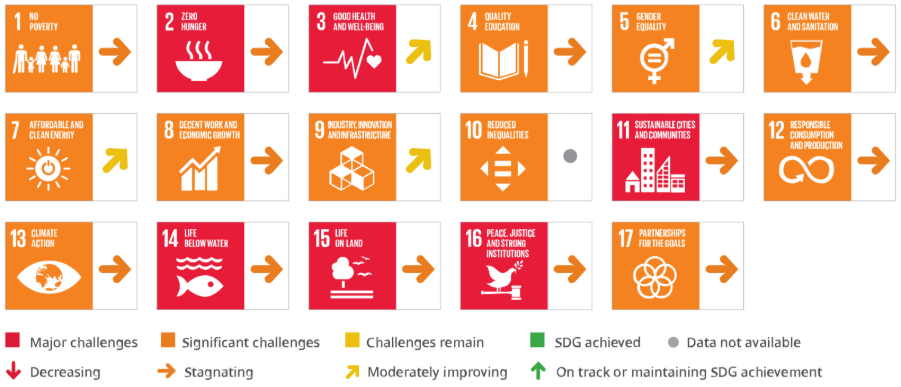
Source: SDSN – Sustainable Development Report 2025.
Challenges slowing SDG progress
- Conflicts and security issues: Countries affected by conflict, political instability, or security challenges often record the lowest SDG Index scores.
- Lack of financing: An estimated USD 3.3 to 4.5 trillion per year is needed to achieve the 2030 Agenda.
- Investment gap: Developing countries lack the capacity to invest the necessary annual resources to meet the SDGs.
- Gender inequality: Greater focus is needed on gender equality and the empowerment of women.
Analysis of SDG progress
Insufficient and threatened progress
Analysis of the 2025 Report shows that, at a global level, progress toward the Sustainable Development Goals has been insufficient. Looking ahead to 2030, several goals remain far from being achieved, particularly SDG 2 (Zero Hunger), SDG 11 (Sustainable Cities and Communities), SDG 14 (Life Below Water), SDG 15 (Life on Land), and SDG 16 (Peace, Justice, and Strong Institutions). Overall, only 16.7% of SDG targets worldwide are on track to be met within the established timeframe.
In recent years, many countries have made notable progress in expanding access to basic services and infrastructure, such as electricity, digitalization, and the use of mobile devices. Improvements have also been recorded in key health indicators, including declines in under-five and neonatal mortality. However, these gains are fragile and increasingly threatened by armed conflicts, geopolitical tensions, and the decline in international financing for sustainable development.
Persistent inequalities among countries
Disparities in SDG achievement remain stark. The 2025 SDG Index shows scores ranging from above 87 to below 50, with the lowest performances concentrated in countries affected by armed conflict or high instability. Regardless of their relative ranking, all countries face significant challenges in at least two goals, particularly those related to climate change and biodiversity, largely driven by unsustainable consumption patterns.
At the same time, there is a pressing need to redesign the global financial architecture to ensure adequate financing for global public goods and to advance effectively toward sustainable development. A small number of countries are responsible for a large share of greenhouse gas emissions, many of them with high income levels. Yet the impacts of climate change affect everyone, including lower-income countries that must allocate scarce resources to mitigation and adaptation, such as regions in Africa experiencing severe desertification. This asymmetry is especially critical given that approximately half of the world’s population lives in countries with insufficient capacity to invest in sustainability.
Global rankings
These disparities are clearly reflected in global rankings. Finland continues to lead, with an index score of 87.2, followed by Sweden (85.7) and Denmark (85.3)—positions these countries have consistently held in previous editions, partly due to their high per capita income. At the opposite end, the lowest scores once again correspond to very low-income countries such as South Sudan (41.6), the Central African Republic (45.2), and Chad (46.0), followed by several other countries, primarily in Africa, with SDG Index values below 50.
Among the 117 countries assessed, and considering economic and demographic weight, the United States ranks 44th, China 49th, the Russian Federation 51st, and India 99th. While all four have improved their positions compared to the previous year, they continue to face significant structural challenges across multiple SDGs.
In Latin America, Chile leads the region with a score of 78.05 (35th place), followed by Uruguay (77.4; 38th) and Cuba (76.5; 40th). Uruguay also stands out for its active participation in submitting voluntary national reviews to the UN, prepared by the National Institute of Statistics (INE) in coordination with various public institutions and with the support of the United Nations.
The cost of inaction
Failure to meet the SDG targets would have profound and lasting consequences: continued increases in global temperatures, more frequent and severe natural disasters, accelerated species extinction, and greater societal vulnerability to future crises, including pandemics, food crises, and conflicts. It would also fuel public distrust in international organizations and governments, perceived as having failed to rise to the challenge.
The 2030 Agenda is no longer a distant promise—it is an immediate challenge. The world is moving dangerously close to points of no return, and only urgent, coordinated, and sustained collective action can keep alive the hope of a more just, resilient, and truly sustainable future.
Mayarí Arruabarrena
Sustainable Development Coordinator
Sources
https://www.un.org/
https://www.unsdsn.org/
https://www.unsdsn.org/resources/sustainable-development-report-2025/
https://dashboards.sdgindex.org/
https://news.un.org/es/story/2025/07/1540167
https://uruguay.un.org/es/sdgs